July
13-24, 2026, St Paul, MN
Sponsored by Michigan
State University
(last modified July 23rd, 2026 by Eric Prebys)
Recent announcements can be found here. Please bookmark this link and check it often.
The course catalog page can be found here.
This course is intended as an introduction to the field of accelerator physics and technology and is suitable for senior undergraduate students or students from other fields with a particular interest in accelerator physics. The course is also appropriate for engineers and technicians working in accelerator-related fields who wish to broaden their background.
We will focus on the fundamental principles of acceleration and transport of charged particle beams. A theoretical understanding of the principals, provided through daily lectures, will be coupled to a practical implementation of the concepts through laboratory exercises.
Course personnel:
Lecturer:
Labs:
TAs:
In general any files you need to download for this course will be stored under the Google Drive directory https://tinyurl.com/prebys-uspas-2026-public (equivalent to the “Files” area in Canvas)
All texts for the course are available online, free of charge.
The primary text for the course is "An Introduction to the Physics of High Energy Accelerators", by Don Edwards and Michael Syphers, which is available here, where it can be downloaded in a number of formats.
A secondary text is “An Introduction to Particle Accelerators”, by Edmund Wilson, available here, which is sometimes used as a text for this course. Compared to Edwards and Syphers, it has less depth but more breadth, and is also more up to date.
For the cyclotron lecture of the course, we will use Chapters 3 and 4 of “Understanding the Physics of Particle Accelerators”, by François Méot, available here. If you’re interested, this book includes simulation examples for all chapters in ZGOUBI, a rather obscure simulation program written in FORTRAN and dating back well into the last millennium. Good luck getting it to run!
Finally, the Fermilab "Concepts Rookie Book" - written for Fermilab Accelerator Operators provides a good overview of accelerators, particularly for beginners. It's a bit Fermilab-centric, but chapters II-IV are fairly generic.
Either previous coursework or a general understanding of classical mechanics and electromagnetism. Courses in special relativity (at the level of "Special Relativity" by A.P. French or "Introduction to Special Relativity" by Robert Resnick), classical mechanics and electrodynamics (at the level of "Introduction to Electrodynamics" by David J. Griffiths) at a junior undergraduate level or higher.
It is the responsibility of the student to ensure that he or she meets the course prerequisites or has equivalent experience.
It’s strongly recommended that you read chapter 1 of Wilson’s textbook, particularly if you have little familiarity with accelerators. Reading chapters II-IV of the Rookie Book is probably also a good idea.
A practice problem set has been uploaded here. This set will not be collected or graded, but it gives a good idea of the mathematical level of the course. In particular, the first two problems involve matrix operations, and we’re going to be doing a lot of those.
The simulation labs and some of the homework will use Jupyter Notebooks and the new Xsuite simulation package, which has replaced MADX as the CERN standard. There are online options for running these things, but it’s better to set them up on your own computers, which is described in detail here. People with lab- or university-managed computers should do this well in advance, since it might require IT assistance.
We will probably do some exercises using the traditional MadX program, which will run on all operating systems. Instructions for downloading it can be found here.
If you’re an absolute newbie to Python and Jupyter, I recommend you familiarize yourself with them before the course. There are lots of tutorials out there, most of them horrible. I found this one to be a very concise quick start (14 minutes). It’s done in Colab, so the interface is a bit different than your local instance, but you should be able to follow it.
Parts of the course involve tedious calculations. You’re encouraged to use a spreadsheet and/or Jupyter Notebook to make things easier. Either will be allowed on the final.
Except where otherwise specified, you can use symbolic manipulation programs for matrix and vector operations: Mathematica, Octave, SymPy, etc.
Some use of AI is allowed to assist you. For example, you can ask AI how to do a specific operation in Python. However, unless you work through the problems yourself, you won’t learn the material, and AI will NOT be allowed on the final. AI will be discussed in detail in the first lecture. Details will be discussed in class, but the official USPAS AI policy can be found here.
Lectures can be found here.
Comments:
These slides were made on a Mac. I believe after years of suffering, all the incompatibilities with Windows have finally been worked out.
If you want to recycle any of these slides, be aware that some equations were made long ago with MathType, which is no longer supported, so they can’t be edited. Newer equations were made with LaTeXiT, which is available only for MacOS. In that case, you can edit an equation by dragging it into the LaTeXiT display windows, editing it, and then dragging it back. The only way to know which is which is by trial an error.
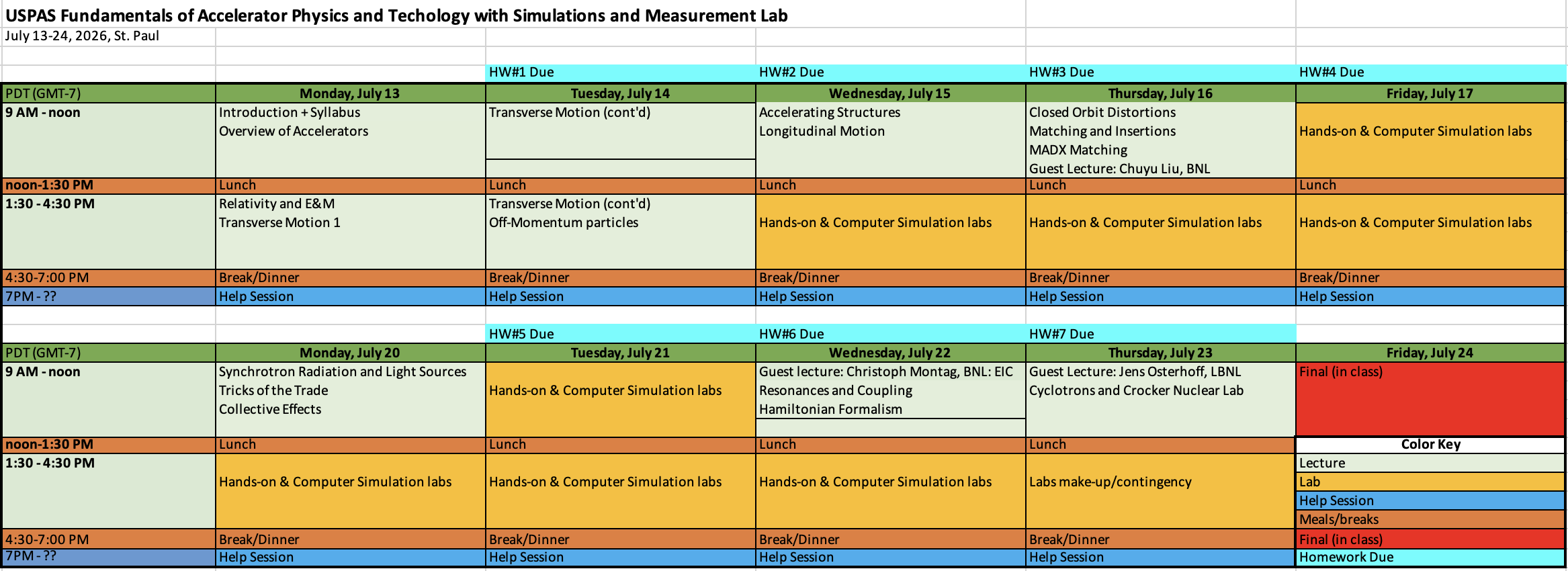
Thursday, July 16th::Orbit Correction, Chuyu Liu, BNL.
Wednesday, July 22nd: The Electron-ion Collider, Christoph Montag, BNL (via Zoom)
Thursday, July 23rd: Wakefield Accelerations, Jens Osterhoff, LBNL (Zoom, TBC)
Hands on labs can be found here.
Simulation labs can be found here.
Homework can be found here. It will be assigned each day, with the exception of:
Friday, July 16th (no homework over the weekend!)
Thursday, July 23rd (study for final)
Unless otherwise specified, homework will be due the next morning. Solutions will be posted in the afternoon after homework is collected, so late homework will not be accepted.
Final exam will be given in class, the morning of Friday, July 24th.
The final will be open book, open note. You can use downloaded copies of the texts and lecture notes, but you will be required to turn off your WiFi during the exam.
The course will end at noon.
All homework, labs, and the final will be turned in and processed using GradeScope. The link for the course is here. (course code available from instructor).
You’ll upload your own homework and labs. The final will be done on paper and scanned in by the staff.
Grade is based on:
Homework: 20%
Labs: 40%
Final: 40%